WVU Health Design System
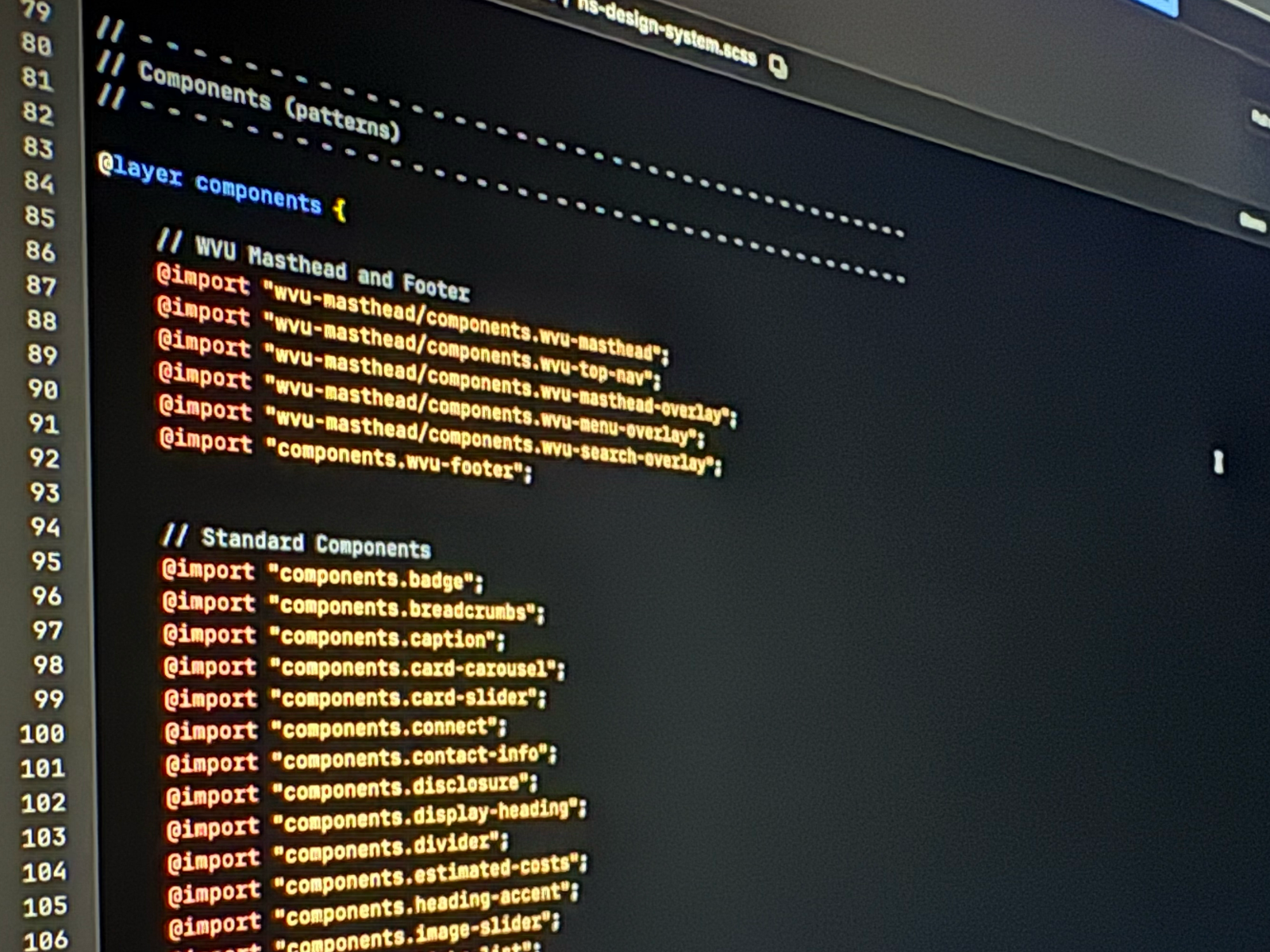
The WVU Health design system is built on strong core design principles and a scalable foundation that supports consistency, accessibility and long-term growth.
By unifying layouts, styles and behaviors across websites, the system reduces redundancy while ensuring alignment with WVU brand patterns, and adherence to accessibility standards.
The framework prioritizes consistency without rigid uniformity, balancing clear standards with design flexibility. Components share core principles and patterns rather than identical appearances.
The system uses a modified ITCSS architecture with BEM methodology, leveraging native cascade layers to manage specificity and prevent conflicts.
- Sass handles logic-driven tasks, including managing nesting, defining variables for block-level classes, creating mixins, performing calculations, and handling iterations.
- Thoughtfully-structured HTML hierarchy is paired with purpose-driven class selectors, avoiding element selectors and utility classes to keep styles consistent, reusable, and maintainable.
- Extra levels of HTML with distinct, non-competing classes are encouraged to clarify structure rather than stacking multiple responsibilities onto a single element.
- In Sass, nesting depth is limited to two levels to keep styles readable, maintainable, and prevent over-specificity.
- CSS variables drive all configurable properties and design tokens, including colors, fonts and decorative values. Components define their own default variable values locally rather than globally at the root.
- Simple grids, such as halves, thirds, and fourths, promote predictable, reusable structures.